| |
Corsa all'Anello
The
main feast in medieval Narni was dedicated to the Patron Saint Giovenale,
taking place each year on the 3rd of May.
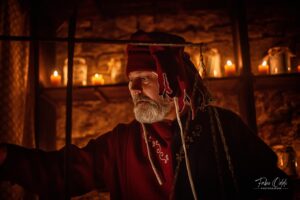
During this festival the whole town of Narni contributes to recreate the
atmosphere of 1371, year of the first written city laws.
Flags and torches adorn squares and streets, taverns and
pizza ovens
emanate into the streets typical fragrances of Umbrian meals and very
good wines.
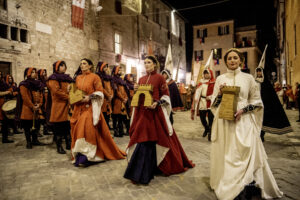
The whole town hosts medieval sounds and colours. Historical
processions, art exhibitions, folk shows, concerts,
competitions
among the terzieri all combine to transform the town into a medieval
picture.
The
town is divided into 3 parts or terzieri, named Mezule, Fraporta and
Santa Maria and each has different colours to be recognized by everyone.
The town crier reads the traditional ban and the taverns
are open: this is the beginning of a feast which dates back to the first
half of the 14th century. This festival comes to its highest point on
the 3rd of May, when the Saint Patron of Narni - S.Giovenale - is
celebrated by all the people in the town.
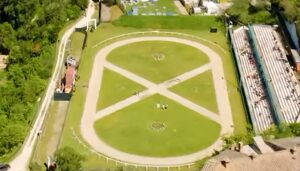
Following
the rules and regulations prescribed by the medieval town laws, dating
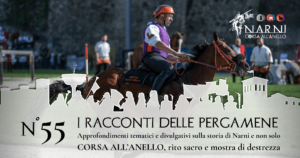
back to the year 1371, the riders participate in the historical “Race to
the ring” - wearing their
medieval costumes- riding their horses,
trying to drive their lances through a silver ring. The riders come to
the main square of the town, the present Piazza dei Priori, which once
was called “Platea Maior”.
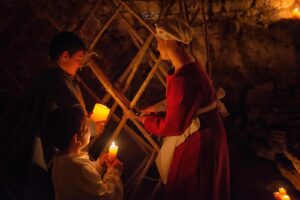
Among the main events during the festival, we cannot
forget the Offer of the Candles in the Cathedral, taking place on the
2nd of May. This evocative display reminds us of the city's authorities
offer of candles (brought also by the representatives of castles and
guilds) to the tomb of the Patron Saint Giovenale on the occasion of his
feast.
During
the two weeks preceding the race, the whole town turns to be the stage
for religious and civic plays, and several medieval shows are organised
by each “Terziere” (i.e. the part the town is divided into): from the
blessing of the riders to the flag throwers’ shows, ending up with the
historical procession on the last Saturday, just before the racing day.
Narni
Historical notes
 |
The
area around Narni was already inhabited in the Palaeolithic and
Neolithic Ages, as attested by finds made in some of the caves.
In historic times, the place was first settled by the Umbrians
who called the town Nequinum; following the conquest by the
Romans the name was changed into Narnia,
owing this name to the river Nar. In the 9th century
Narni flourished economically and culturally, thanks to the
presence of the consular road Via Flaminia connecting Rome to
the Adriatic Sea. |
The
changes were radical: the Platea Major replaced the Roman Forum; large
civil and religious buildings were built such as the Magistrate's
Palace, the Palace of Priors and the Cathedral dedicated to Saint
Giovenale. In the 14th century Narni became part of the
territories controlled by the papacy and accordingly lost its
independence. Under the papacy of Gregory XI, Cardinal Albornoz had an
imposing Fortress built overlooking the town from the hill. The loss of
political independence led to economic and cultural decadence. This is
the time of the pillage made by the
German
soldiers (the so called Lanzknechts) (17th July 1527) and of
the following plague. The town was not destroyed but the loss of human
lives was anyway heavy.
The
following centuries, until the time of the Resurgence, were not marked
by any important event, although the ideals of Mazzini and the
republican ones had many followers in Narni. This fact strongly
influenced the local powers between the late 19th and the
early 20th century. During that period the first large
industries came to Narni, and economic, as well as cultural and social
structures, rapidly changed in consequence of this, leaving deep marks
on the landscape too.
Monuments
 |
The Fortress of Albornoz
It
lies on a hill at an altitude of 406 m a.s.l. built upon a
former monastery devoted to St. Mary Magdalene, between 1360 and
1378, on account of Cardinal Albornoz, who in the same years
also had the fortresses of Spoleto, Viterbo, Assisi,
Montefiascone and Orvieto built.
The Fortress is square shaped, with towers at its corners. The
highest tower, the donjon (or Maschio in Italian) |
can be reached by way of a spiral staircase, from
within the courtyard which is also square and has at its centre a
cistern in travertine with an octagonal mouth.
The
building is surrounded on three sides by a moat, while the walls on the
fourth side are supported by a rock jutting out over a precipice. From
the outer walls, long walls lead to the west heading to the Via Flaminia,
where the Roman City Gate and the Feronia Gate were located and, to the
east until the old nunnery of S. Croce. Restoration and fortification
works followed each other during the following centuries, bringing
additions and modifications. The Fortress has now been completely
restored and measures 1596.05 m2. distributed on four levels.
|
Augustus’ Bridge
It was built around 27 B.C. and it was used as
the old passage of the road Via Flaminia. The bridge must have
had three or four arches, of which only the first - and possibly
the largest one - can be seen today, with the ruins of two other
pillars. The brickwork was completely embossed. The bridge was
160 m long, and the remaining arch is 30 m. high. It is an
exceptional example of the Roman Golden Age in terms of
perfection of craftsmanship and originality of the construction.
|
 |
 |
Cathedral
It
was consecrated in 1145. It has a renaissance portico (1490) and
3 access portals. The interior is divided into 4 naves. In the
Cathedral you can admire these works of art: an early
fifteenth-century fresco of the Madonna and Baby by an anonymous
local master; The Chapel of the Holy Sacrament with an arc of
triumph covered in bas-reliefs dated 1490; the Oratory of St.
Cassius, an important Christian archaeological monument in which
St. Giovenale, bishop and patron saint of the town, was buried
in 376 AD, and later his successors; the Chapel of the Blessed
Lucia containing paintings by Trevisani dated |
1710; The Chapel of St.
Joseph, the Confession by the architect Paglia; the altar of St. Biagio
and the altar of St. Peter with a painting by Agresti. In the Chapel
called "Coretto d'Inverno" (Winter Choir), there is a fifteenth-century
painting on board of the Madonna of Consolation. The central nave has a
sequence of lowered arches characteristic of Romanesque architecture in
Narni, and at the end of it there are some remains of thirteenth and
fifteenth-century frescos.
The apse is an original and rare example of Gothic architecture with
French influences (14th century)
|
Palace
of the Priors and town Hall
The
Palace of the Priors, attributed to Gattapone, looks down onto
the homonymous square, formerly known as Platea Major, and it
was the headquarters of the town magistracy in medieval times.
The portal with its small town-crier's loggia and the majestic
loggia with two daring arches supported by a central octagonal
ribbed pillar are interesting too see. Opposite the Palace of
the Priors stands the Town Hall, headquarters of the highest
authorities. |
 |
The
building is the result of the adaptation of 3 towers turned into houses,
acquired by the Municipality in 1282.On the upper floor there are six
fifteenth-century windows, while on the facade there are sculptures of
animals and mutilated statues. The tombstones commemorate the citizens
of Narni or famous governors. In the entrance hall there are some
archaeological finds from the town and surrounding areas. In the council
Hall we can admire the famous Altarpiece by Ghirlandaio depicting the
coronation of the Virgin.
|
Narni Underground
These
are the areas underneath the ancient convent of the church of
St. Dominic, consisting of an early Roman church, with
thirteenth and fifteenth-century frescos, a Roman cistern and a
prison cell used by the tribunal of Inquisition, where the
graffiti the prisoners scratched on the walls can be seen, some
of which are still to be deciphered. the underground areas of
Santa Maria Impensole consist of an eighth-century church with
three naves, built on top of the ruins of a Roman temple, turned
into a crypt in the XII century, it now still has two Roman
cisterns, one of which still well preserved. The Roman aqueduct
of the Formina can be accessed from the tunnels of St. Biagio,
San Silvestro and Mount Ippolito. |
 |
|
ù |